
Rudolf Flesch Literacy Campaign
Why Johnny Can't Read and what you can do about it
Phonics-First Reading Program
The Book: In 1955 Dr. Rudolf Flesch published his best-selling Why Johnny Can’t Read and what you can do about it. The dual nature of the title reflects the dual nature of the book. Flesch first presents the Problem and then provides the Solution. The Problem was the look-and-say method and the Solution was Phonics-First. Here is a free Archive copy you can read Online: Why Johnny Can’t Read. Here is the Archive copy of Flesch’s 1981 Why Johnny STILL Can’t Read. Most people are not aware that Flesch published a phonics book in 1956, Teaching Johnny to Read.
The Proof: It is extremely easy to prove that Flesch is correct on both accounts by simply putting his phonics-first method to the test: teach some students with it. I have personally done just that many times and am thoroughly convinced that Flesch was correct. Mr. Edward Miller has found Flesch’s phonics exercises very effective as verified by his test for artificially induced-dysleixa. MWIA 2016 Revision. Here is Dr. Samuel L. Blumenfeld’s article, “Can Dyslexia Be Artificially Induced in Schools?” Here is my 2008 video Explaining the MWIA.
The Method: Phonics-first means teaching phonics BEFORE any sight-words. To assist parents and professional educators who wish to save children from the ravishes of illiteracy, I am producing this easy-to-follow set of audio lessons (mp3 format) for teaching the five-steps of Flesch’s phonics-first program. Flesch’s program is unsurpassed for both beginning students and remedial students of all ages. Flesch’s book can be purchased from your local book store or Amazon.com.
The Universal Safety Net for Literacy. I would suggest that every school in America every year require every student from first grade through at least sixth grade to read through Flesch’s 72 Exercises once each year. The reading should be timed to make sure the students have established automaticity. This would fulfill four important functions:
1. It would provide universal screening that would instantly determine if a student has a reading problem the decoding level.
2. It would provide a superior phonics-first program for beginning readers of all ages.
3. It would provide all the necessary remediating to help struggling readers increase their reading ability.
3. It would provide good readers an opportunity to further improve their decoding and spelling skills.
Audio Instruction for
The Five Steps of Flesch’s Phonics-First Home Primer
Recordings can be downloaded and used for free for non-commerical purposes only.
Copyright © 2005 Donald L. Potter. All Rights Reserved
1. The Five short vowels and all consonants spelled with one letter. Exercises 1 – 12
2. Consonants and consonant combinations spelled with two or three letters. Exercises 13 – 23
3. Vowels and vowel combinations spelled with two or three letters. Exercises 24 – 39
4. The five long vowels. Exercises 40 – 59
5. Irregular Spellings. Exercises 60 – 71
My Natural Phonics Primer™ Materials,
which Analyze and Apply Flesch’s Method.
1. 44 English Speech Sounds – Chart
2. Natural Phonics Primer – How to Make One.
3. Natural Phonics Primer™ – How to Teach It
4. Natural Phonics Primer™ with Blend Phonics
5. Natural Phonics Primer Progress Chart.
6 Foundation for Phonics: 26 Letters for 44 Speech Sounds
7. Natural Phonics Primer™ Certificate of Completion
8. Natural Phonics Primer List of Exercises: published 9/23/2006. Phonovisual correlation added in Feb. 2014.
9. Natural Phonics Primer™ Vocabulary Study
10. Natural Phonics Primer™ Oral Reading Speeds. This is a Precision Teaching approach for automaticity.
11. Natural Phonics Primer™ Phonogram Chart This is for people familiar with Romalda Spalding’s Phonograms.
12. Natural Phonics Practice Sentences Reading practice with decodable sentences.
13. Transparency Masters. Flesch’s 72 Exercises in large print (Lowercase)
14. Transparency Masters. Flesch’s 72 Exercise in Small Caps (Uppercase)
15. Natural Phonics Primer: A Universal Safety Net for Literacy
Flesch's Instructions
Notes to Parents and Teaches – From Teaching Johnny to Read (1956). These are the same exercises published in his 1955 book. Most people are not aware that Flesch published a separate reading method.
Rudolf Flesch’s Three Principles for a Successful Nationwide Literacy Campaign
Victory Drill Book
The original Victory Drill Book was punished by August C Enderlin in 1970. It was “A phonetic approach to reading with an emphasis on speed. I spoke with Mr. Enderlin in 1998 and 2003 concerning his program. The idea of timing phonics exercises came from Mr. Enderlin’s pioneering work. The drills in the original 1970 VDB essentially the same as Flesch’s Johnny.
Chart Phonics Supplement
While not a part of Flesch’s program, I have found the Phonovisual Charts very helpful when used in combination with Flesch’s Exercises. Unfortunately, in 2025 the program disappeared from the Internet and has apparently ceased publication. It was published from 1942 to 2025! I plan to make the essential compoments of the program available for free on this website. Here is my Natural Phonic Primer: Phonovisual Chart Correlation.
Phonics Programs that Dr. Flesch Recommended
Flesch personally taught Johnny used the 1936 Hegge-Kirk-Kirk Remedial Reading Drills. They are available for free from my website. They are highly effective. A “Teacher’s Manual” is included. Interestingly, Samuel A. Kirk and Winifred D. Kirk wrote an essay critical of Flesch’s Johnny, “How Johnny Learns to Read.” Current reading theory debunks the popular whole-word method that Kirk-Kirk used to criticize Flesch. Flesch has been completely vindicated by modern research.
Here is a 1955 review of Flesch’s Why Johnny Can’t Read by Spencer Bown, “On the Horizon: Dr. Flesch’s Cure for Reading Troubles.”
Flesch gave an eyewitness account of the 1948 Hay-Wingo Reading with Phonics in his 1955 Johnny. I have written a study of that method and the Teacher’s Manual.
1. Hay-Wingo Reading with Phonics: Student’s Book
2. Hay-Wingo Reading with Phonics: Teacher’s Manual
You can find the first picture below in A History of The Book in America, Volume 5. The Enduring Book, Print Culture in Postwar America, edited by David Paul Nord, Joan Shelley Rubin, and Michael, Schudson. The University of North Caroline Press, 2009, p. 416. I am honored to represent Flesch in the good light he so richly deserves.
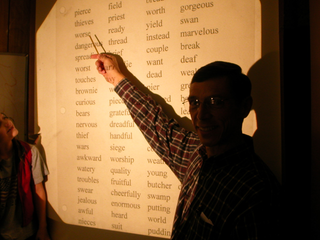
Don teaching Flesch from an overhead.
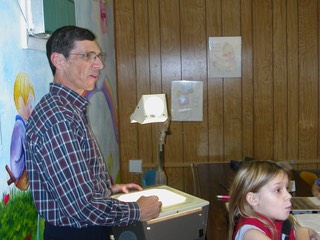
Don and one of his students.
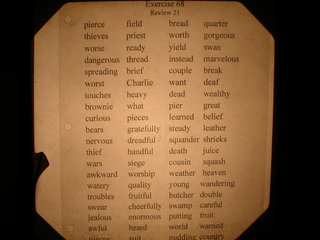
A close-up of Exercise 68, Review 21
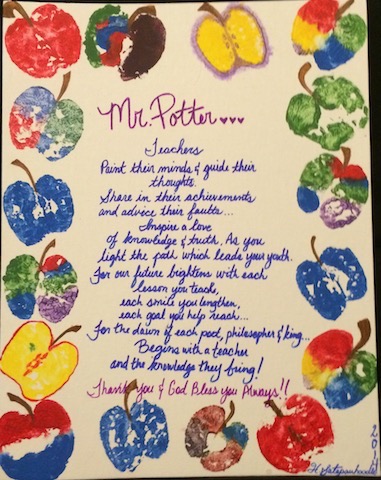
The poster below is from a student Mr. Potter taught Rudolf Flesch’s
72 Exercises. She became an excellent reader.
Page last revised on September 1, 2023, April 27, 2026.
© Don Potter.net Wide Interest Website 2026